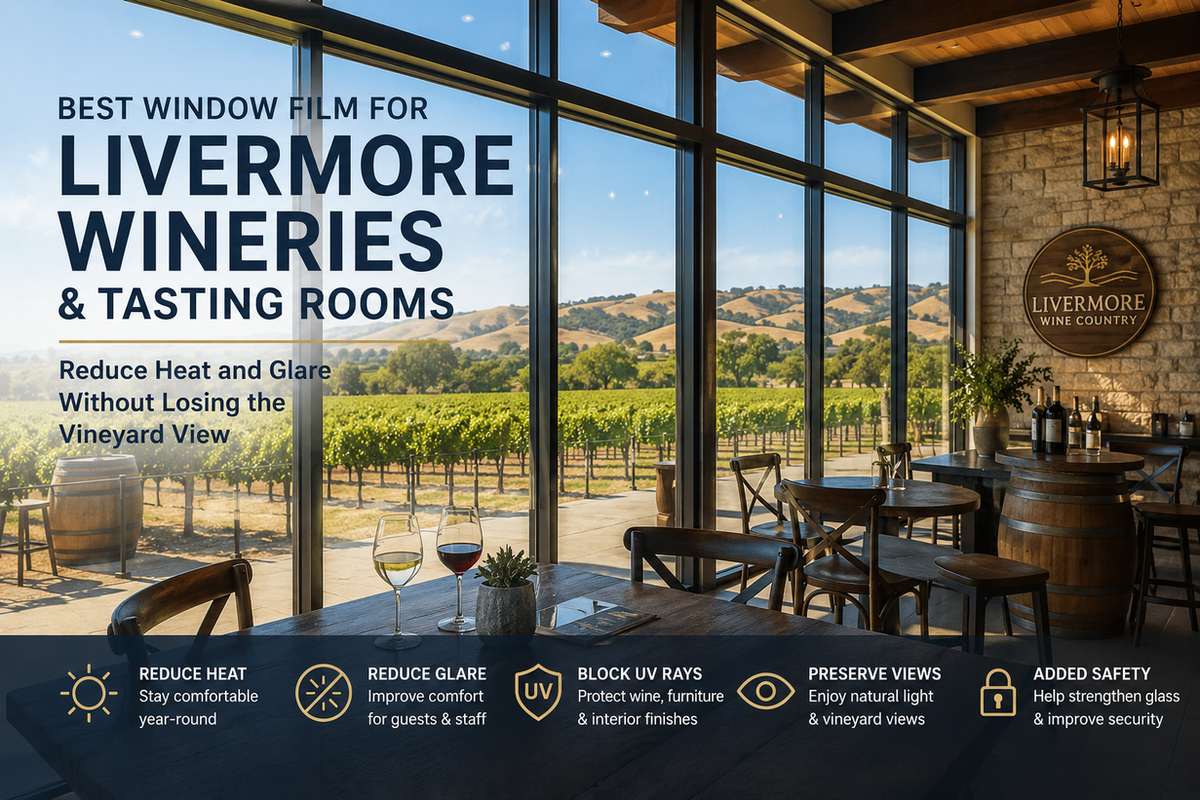
Large windows are one of the best features a Livermore winery or tasting room can have. They bring in natural light, make the space feel open and allow guests to enjoy the surrounding vineyards and hills.
However, the same glass that creates the view can also create uncomfortable afternoon heat, harsh glare, fading and uneven temperatures inside the building.
Closing the blinds may reduce the problem, but it also eliminates the view that makes the space special. Replacing the glass can be expensive and disruptive. Professionally installed commercial window film offers another option—but choosing the correct film requires more than selecting the darkest shade available.
The best window film for a Livermore winery depends on the direction the windows face, the type of glass, how the room is used and how much change in appearance the property owner is willing to accept.
The Honest Answer: There Is No Single Best Film for Every Winery
A tasting room trying to preserve a nearly unchanged vineyard view may need a different product than a west-facing event room experiencing severe afternoon glare.
Before choosing a film, the winery should establish its priorities:
- Reduce heat while preserving as much natural light as possible
- Reduce direct glare on guests, employees, screens or point-of-sale systems
- Protect flooring, furniture, artwork, labels and retail displays from sun exposure
- Create privacy in offices, storage rooms or private event areas
- Improve the appearance of the building from the outside
- Add protection against broken or shattered glass
One film may address several of these concerns, but no product maximizes every benefit without a tradeoff.
For example, a very light film may provide meaningful solar control while maintaining a bright interior. However, it may not solve severe glare because glare is directly related to the amount of visible light entering the room.
A darker or more reflective film can provide stronger glare control, but it will create a more noticeable change in the glass.
The correct solution is therefore not the film with the largest performance number. It is the film that produces the right balance for the specific area.
Why Livermore Tasting Rooms Can Develop Heat and Glare Problems
The severity of a solar-control problem depends on more than the outside temperature.
Important factors include:
- Window orientation
- Time of day
- Amount of exposed glass
- Existing roof overhangs or exterior shading
- Interior ceiling height
- Glass type and coating
- Distance between the windows and guest seating
- HVAC capacity and vent placement
- Interior colors and reflective surfaces
South- and west-facing windows commonly receive stronger direct sunlight during significant portions of the day. A large wall of glass can create a noticeably warmer perimeter zone even when the central part of the tasting room remains comfortable.
This can affect more than customer comfort. Employees stationed near the glass may experience heat and eye strain, while glare can make digital menus, reservation screens and point-of-sale systems difficult to see.
A proper recommendation should examine the room during the period when the problem is most severe—not only early in the morning when the glass may appear comfortable.
Option 1: Spectrally Selective Film for Maximum View Preservation
Spectrally selective window films are designed to control solar energy while allowing a relatively high level of visible light to pass through the glass.
These films are often a strong starting point for:
- Main tasting rooms
- Scenic vineyard-facing windows
- Hospitality areas where natural light is part of the design
- Properties that do not want a heavily tinted or mirrored appearance
- Rooms with heat concerns but only moderate glare
The main advantage is appearance. A lighter spectrally selective film can preserve a more natural view from inside and create less visual change from outside.
The limitation is glare reduction. If direct afternoon sunlight is washing out screens or forcing guests to move away from the windows, an extremely light film may not be sufficient.
This is where some window-film proposals become misleading. A product can have strong infrared or solar-energy performance while remaining visually light, but that does not mean it will eliminate glare. If glare is the primary complaint, visible-light transmission must be considered alongside heat rejection.
Option 2: Neutral Solar-Control Film for Balanced Performance
Neutral window films reduce heat and glare without creating the highly reflective appearance associated with traditional silver films.
They are often appropriate for winery owners who want:
- More glare reduction than a nearly clear film can provide
- A natural gray or neutral appearance
- Better temperature balance near the windows
- A comfortable view from inside
- Less exterior reflectivity than a traditional mirrored film
Neutral films are available in different light-transmission levels. A lighter version may be suitable for the primary tasting room, while a medium shade may work better on a heavily exposed wall or in an event space.
Using different films in different areas can be more effective than forcing one product onto every window. However, films should still be coordinated carefully so the exterior of the building does not appear inconsistent.
Option 3: Dual-Reflective or Reflective Film for Severe Heat and Glare
Reflective and dual-reflective films generally provide stronger solar and glare control than lighter, view-preserving options.
They can make sense for:
- West-facing glass receiving intense afternoon sun
- Large event spaces that become uncomfortable during peak hours
- Employee work areas with severe screen glare
- Windows where performance matters more than maintaining the lightest possible appearance
- Buildings where a more uniform or reflective exterior is acceptable
Dual-reflective films are designed with a more reflective exterior surface and a less reflective interior appearance. This can improve daytime views from inside compared with films that are highly reflective on both sides.
The tradeoff is still visible. A higher-performance reflective film will normally alter the exterior appearance of the glass and reduce interior brightness more than a light spectrally selective film.
Film samples should be viewed on the actual windows before the final selection. Small samples are useful, but a larger temporary sample is better for evaluating color, reflectivity and the view from different angles.
Option 4: Clear UV-Control Film for Displays and Interior Protection
Some wineries are less concerned about heat and more concerned about long-term sun exposure on:
- Wood flooring
- Artwork
- Photographs
- Merchandise
- Wine labels
- Interior finishes
- Retail displays
A light or nearly clear UV-control film may be appropriate when the objective is to add protection without materially darkening the glass.
However, fading is not caused by UV exposure alone. Visible light, heat, materials, dyes and environmental conditions can also contribute. Window film can help slow the process, but it cannot guarantee that furniture, labels or finishes will never fade.
The exact UV performance should be confirmed using the manufacturer’s specifications for the selected product.
Decorative Film for Offices, Private Rooms and Interior Glass
Not every film in a winery needs to be a solar-control product.
Decorative or frosted window film can be used for:
- Administrative offices
- Employee areas
- Private tasting rooms
- Event-room partitions
- Storage areas
- Conference rooms
- Glass doors
- Restrooms
- Areas requiring permanent privacy
Frosted film provides privacy during both the day and night because it obscures visibility instead of depending on a lighting difference.
This is different from reflective privacy film. Reflective films can increase daytime privacy when the exterior is brighter than the interior, but that effect can reverse after dark when the interior lights are on.
For spaces that require privacy regardless of lighting conditions, frosted or opaque decorative film is usually the more reliable option.
Decorative film can also incorporate custom bands, patterns, logos or visual markers. This allows the glass to support the winery’s design and branding instead of appearing like a generic office partition.
Safety and Security Film Is a Separate Decision
Solar-control film and safety film are not automatically the same product.
Safety and security films are thicker systems designed to help hold broken glass together after impact. Depending on the purpose of the installation, the system may also require a perimeter attachment to the window frame.
Potential applications in a winery include:
- Large glass entrance doors
- Windows near guest seating
- Vulnerable storefront-style glazing
- Interior glass partitions
- Areas where accidental glass breakage presents a concern
- Windows containing valuable merchandise or equipment
Safety film should not be described as making glass unbreakable. It is intended to improve post-breakage performance and may delay access, depending on the complete glass, film, frame and attachment system.
A winery needing both solar control and safety performance may use a solar safety film or a compatible multilayer solution. The specifications and warranty should be confirmed before installation.
What Matters More Than the Word “Ceramic”
“Ceramic” is often used as a marketing term, but it does not provide enough information to select a commercial window film.
A winery should compare measurable performance characteristics, including:
Visible Light Transmission
Visible light transmission indicates how much visible light passes through the film and glass.
A higher number generally creates a brighter, more transparent appearance. A lower number generally provides stronger light and glare reduction.
Total Solar Energy Rejected
Total solar energy rejected evaluates the combined effect of reflected, absorbed and transmitted solar energy.
This provides a broader picture of solar performance than looking only at infrared rejection.
Interior and Exterior Reflectance
Reflectance affects the appearance of the windows from both sides.
A highly reflective exterior may provide a modern, uniform appearance, but it may not match the architecture or branding of every winery.
Higher interior reflectance can also create a stronger mirror effect at night.
Glare Reduction
Glare reduction is closely connected to visible-light reduction. A nearly clear film should not be expected to solve the same glare problem as a medium or darker solar-control film.
Glass Compatibility
The film must be approved for the existing glazing system. The evaluation may include:
- Single-pane or dual-pane glass
- Clear, tinted or coated glass
- Low-E coatings
- Tempered glass
- Laminated glass
- Existing film
- Glass thickness
- Window size
- Interior shading
- Seal and glass-manufacturer limitations
Selecting a film only by shade or heat-rejection percentage can create avoidable risk.
Interior Versus Exterior Window Film
Most architectural window films are installed on the interior surface of the glass, where they are protected from weather and are generally easier to maintain.
Exterior film may be considered when:
- The interior surface is inaccessible
- The glass or coating requires an exterior application
- Interior construction prevents proper installation
- The selected exterior product provides a better solution for the glazing system
Exterior films are specifically manufactured for outdoor exposure. An interior-only film should not be installed outside.
The installer should identify the glass and evaluate product compatibility before deciding which surface to use.
The Best Practical Strategy for a Livermore Winery
For many wineries, the best solution is not one film installed throughout the entire property.
A more precise approach may look like this:
Main Scenic Tasting Room
Use a lighter neutral or spectrally selective film to reduce solar heat while preserving the vineyard view and natural-light character of the room.
West-Facing Windows
Evaluate a medium neutral or dual-reflective film if afternoon heat and glare are severe. This area may require stronger visible-light reduction than the rest of the building.
Point-of-Sale and Screen Areas
Address the windows directly causing screen glare instead of automatically darkening every window.
Private Event Rooms
Choose a film based on how the room is used. A medium solar-control film may improve comfort during daytime events, while decorative film may provide privacy for private functions.
Offices and Employee Areas
Use decorative, frosted or solar-control film depending on whether the priority is privacy, glare or temperature control.
Entry Doors and Vulnerable Glass
Evaluate safety or security film separately from the solar-control scope.
This area-by-area strategy can provide better performance and preserve the intended design of the property.
Can Window Film Reduce Heat Without Ruining the Vineyard View?
Yes, but expectations must be realistic.
Lighter films can reduce a portion of the solar energy entering through the glass while preserving a relatively clear view. They can be an effective choice when heat is the main concern and glare is moderate.
When glare is severe, stronger light reduction will normally be necessary. The windows will look darker because reducing glare requires reducing visible light.
The goal should not be to promise an invisible film that solves every solar problem. The goal should be to select the lightest film that provides enough performance for the actual conditions.
That decision is best made by viewing samples on the glass during the time of day when the heat or glare occurs.
Installing Window Film Without Disrupting Winery Operations
A commercial window-film project can often be scheduled around tasting-room hours.
Depending on the size and access conditions, installation may be completed:
- Before opening
- On closed weekdays
- In phases
- One room at a time
- Around scheduled events
- During lower-traffic periods
The work area will need to be accessible. Tables, displays, merchandise or furniture near the windows may need to be moved temporarily.
High windows, exterior glass and difficult terrain may require ladders, scaffolding or lift equipment. These conditions should be identified before the proposal is finalized.
The installer should also explain the curing process. Newly installed film may temporarily show moisture, haze or small water pockets while the mounting solution dries. This is normally part of the curing process and does not necessarily indicate a defect.
What Should a Commercial Window-Film Proposal Include?
A professional proposal for a Livermore winery or tasting room should clearly identify:
- Areas and windows included
- Approximate glass measurements
- Selected film or film options
- Performance specifications
- Interior or exterior application
- Existing-film removal, if required
- Glass-preparation requirements
- Access equipment
- Furniture or display movement
- Installation schedule
- Warranty terms
- Exclusions and assumptions
- Total price
- Optional alternates
Be cautious with proposals that specify only “ceramic tint” or “heat-control film” without identifying the manufacturer, product and measurable specifications.
Different films can look similar on a small sample while performing very differently.
Frequently Asked Questions
Will window film make our tasting room too dark?
Not necessarily. Commercial films are available in light, medium and darker options. A lighter film can preserve more natural light, while a darker film provides more glare reduction. Samples should be tested on the actual glass before a final decision is made.
Can we reduce glare and keep the glass completely unchanged?
Not completely. Meaningful glare reduction requires some reduction in visible light. A very light film may preserve the appearance but may not solve severe glare. The objective is to find the lightest film that produces sufficient glare control.
Will the windows look mirrored?
That depends on the film. Spectrally selective and neutral films can create a more natural appearance. Reflective films produce a more noticeable exterior reflection. Lighting conditions also affect how reflective the glass appears.
Can window film be installed on dual-pane or Low-E glass?
Often, yes, but not every film is approved for every glass type. The glazing system and film specifications should be evaluated before installation.
Will guests still be able to see the vineyard?
Yes, when the appropriate film is selected. Lighter and neutral films are frequently chosen for view preservation. Darker films still allow an outward view during the day but reduce brightness more noticeably.
Does window film provide privacy at night?
Reflective solar film does not guarantee nighttime privacy. When the interior is brighter than the exterior, people outside may be able to see inside. Frosted or opaque decorative film is a more dependable option when privacy is required day and night.
Can film help protect wine labels, furniture and flooring?
Window film can reduce UV exposure and, depending on the product, reduce visible light and solar heat. These factors can help slow fading, but film cannot completely eliminate fading.
Can installation be scheduled outside tasting hours?
In many cases, yes. Scheduling depends on the project size, access requirements and the winery’s operating calendar.
How long does commercial window film last?
Service life depends on the product, installation surface, exposure, maintenance and whether the film is installed inside or outside. The written manufacturer’s warranty for the selected film should be reviewed rather than relying on a general lifetime claim.
Request a Window-Film Assessment for Your Livermore Winery
Low Price Window Tint provides professional commercial window-film installation for wineries, tasting rooms, restaurants, offices and commercial properties throughout Livermore, Dublin, Pleasanton and the surrounding Bay Area.
We can evaluate your glass, identify the source of the heat or glare problem and provide film options based on your desired appearance and performance.
To help us prepare an initial recommendation, send:
- Interior and exterior photographs of the windows
- Approximate measurements, if available
- The direction the windows face
- The time of day when the problem is most severe
- Your normal operating hours
- Any concerns about glass appearance, reflectivity or privacy
Call 925-515-2979 or submit a commercial quote request through our website.
Low Price Window Tint California Contractor License #1135467Licensed, bonded and insuredServing Livermore, Dublin, Pleasanton and the greater Bay Area