If you are researching UV protection window film Dublin CA, you have probably seen a lot of marketing language about “blocking heat,” “stopping UV,” or “reducing glare.” But most homeowners in Dublin CA are never really told what those different parts of sunlight actually are.
That matters, because not all sunlight behaves the same way once it hits your windows.
Some of it fades hardwood floors and furniture. Some of it creates harsh glare on TVs and computer screens. Some of it contributes to heat buildup that makes rooms feel uncomfortable in the afternoon. And some of it does all three at once.
To understand what window film really does, it helps to break sunlight into three major categories: ultraviolet light, visible light, and infrared energy. Industry education materials describe the solar spectrum this way, noting that UV sits in the shortest wavelengths, visible light is the part we see, and infrared is the longer wavelength portion we mainly experience as heat. They also explain that roughly 3% of solar energy is ultraviolet, about 44% is visible light, and about 53% is infrared.
For homeowners in Dublin CA, that distinction is important because the best film is not just about making glass darker. It is about controlling the right parts of the solar spectrum for the problem you are trying to solve.
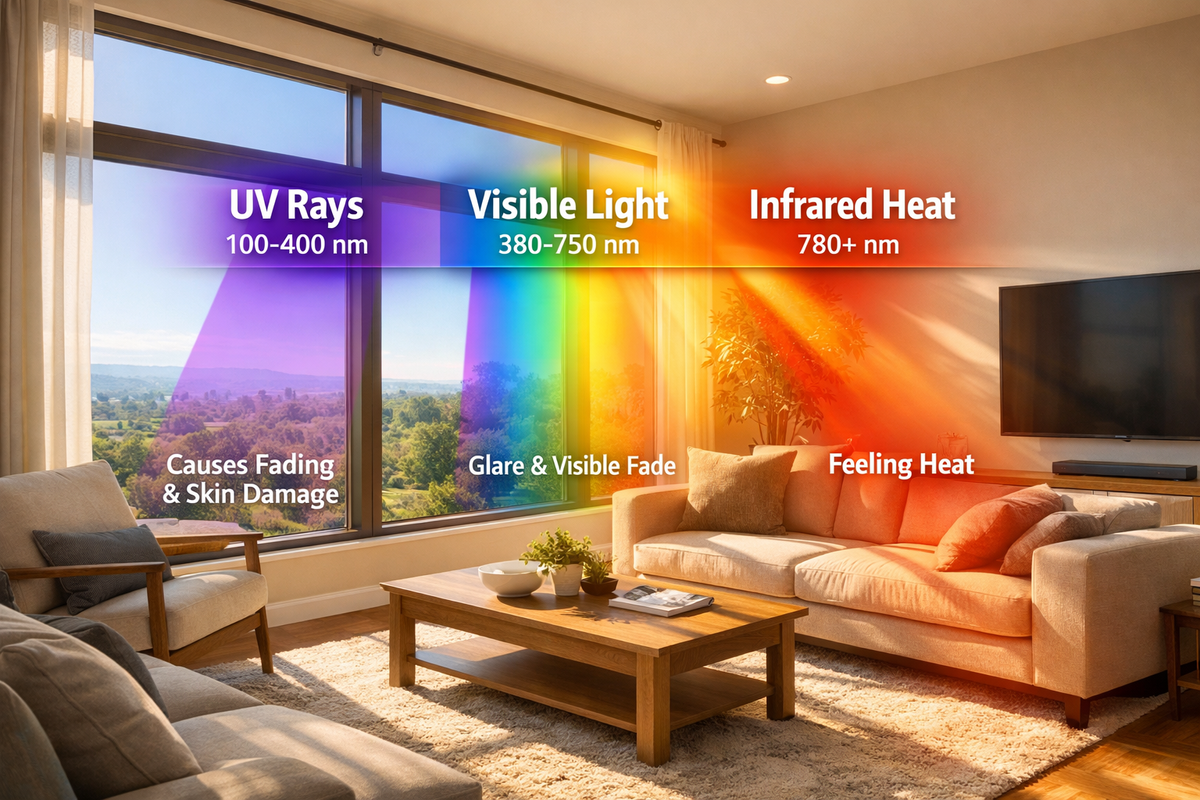
Understanding the Solar Spectrum at Home
Sunlight is a form of radiant electromagnetic energy. In plain English, that means the sun sends energy toward your home in different wavelengths, and each wavelength affects your interior differently. Window film industry education guides explain that homes and offices struggle with comfort, glare, and furnishing deterioration because solar energy pours through the glass and is absorbed by whatever it touches inside.
That is why a bright room in Dublin CA can still feel hot, why a room can look clear but still damage furnishings over time, and why two windows that seem similar can behave very differently.
Ultraviolet Light: Small Percentage, Big Damage Potential
Ultraviolet radiation is the smallest part of the solar spectrum by total energy, but it is one of the most aggressive when it comes to damage. The educational guides break UV into three groups: UV-C from 100 to 290 nanometers, UV-B from 290 to 320 nanometers, and UV-A from 320 to 400 nanometers. The atmosphere blocks most UV-C and some UV-B before it reaches the earth.
For a homeowner in Dublin CA, the practical takeaway is this: UV is one of the main contributors to fading and skin exposure near windows.
Regular glass already screens much of the UV-B range, which is one reason people often do not burn quickly behind residential glass. But that does not mean your home is fully protected. Industry training materials note that glass absorbs heavily in the UV-B range, while window film is designed to absorb UV-A as well, making film a meaningful improvement for blocking aging- and damage-related UV exposure.
That is a major reason people search for UV protection window film Dublin CA. They may think they are shopping for heat control, but often the bigger long-term issue is protecting flooring, furniture, cabinetry, artwork, and other interior finishes.
Visible Light: What You See, and What Causes Glare
Visible light is the part of sunlight your eyes actually perceive. The guides place visible light roughly between 380 and 780 nanometers, though they also note that exact cutoffs can vary slightly depending on the standard used.
Visible light is not just about brightness. It also plays a major role in glare and fading.
That means in Dublin CA, a room may feel “too bright” even before it feels too hot. South- and west-facing windows often create the biggest complaints: washed-out television screens, eye strain at a home office desk, and rooms that are uncomfortable during the brightest parts of the day.
The same educational materials also explain that fading is not only a UV issue. Visible light contributes too. In fact, advanced training materials specifically state that fade protection is influenced by UV protection, lower visible light, and to some extent reduced near-infrared transmission as well.
So if a homeowner in Dublin CA wants the brightest possible room, there is usually a tradeoff. The more visible light you allow through, the less help you get with glare and some aspects of fading control.
Infrared: The Heat Most People Are Actually Feeling
Infrared is the part of the solar spectrum beyond visible red light. The training guides describe infrared as wavelengths greater than red visible light, with near-infrared from 780 to 2500 nanometers and far-infrared from 2500 to 40,000 nanometers. They also explain that infrared makes up the largest share of solar energy reaching the earth’s surface.
For homeowners in Dublin CA, this is usually the missing piece.
When people say, “This room gets hot every afternoon,” they are usually talking about infrared-driven solar heat gain. Some of that energy passes through the glass. Some is absorbed by the glass and surrounding materials, then re-radiated inward. The industry guides explain that when sunlight hits glass, part of the energy is reflected, part is absorbed, and part is transmitted. In the clear-glass example they provide, about 8% is reflected, 9% is absorbed, and 83% is transmitted.
That is why untreated windows in Dublin CA can make certain rooms feel like greenhouses.
Why Fading Is More Complicated Than People Think
One of the biggest myths in the window film world is that fading is only about UV. It is not.
Industry education documents repeatedly describe fading as a complex issue and explain that no film or glazing product can totally prevent or stop fading. They list multiple contributors, including ultraviolet radiation, visible light, humidity and heat, dye fastness, and chemical vapors in the air.
That matters for homeowners in Dublin CA because it helps set realistic expectations.
If your goal is to protect hardwood floors, leather furniture, rugs, artwork, and cabinetry, the best window film strategy is not just “block UV.” It is to choose a product that gives strong UV protection while also addressing visible light and solar heat in a balanced way.
That is also why darker is not always better, and lighter is not always enough. The right answer depends on the room, the glass type, the orientation of the windows, and how much natural light you want to keep.
So What Actually Enters Your Dublin CA Home?
The simplest answer is this:
UV enters your home and contributes heavily to fading and skin exposure.
Visible light enters your home and affects brightness, glare, and some fading.
In Dublin CA, where homeowners often want to keep a bright, open look without giving up comfort, the best window film usually balances all three rather than focusing on only one.
That is the real value behind UV protection window film Dublin CA. It is not just a health or fade product. It is part of a complete glass-performance solution.
If your home in Dublin CA has hot rooms, fading floors, uncomfortable glare, or west-facing windows that become difficult in the afternoon, understanding the difference between UV, visible light, and infrared helps you choose film based on actual performance instead of guesswork.
And that is exactly where professional guidance makes the difference. The right film should match the problem you are trying to solve, not just the look you see on a sample card.
Final Thoughts for UV protection window film Dublin CA
When sunlight comes through your windows in Dublin CA, it is not one simple thing. It is a mix of ultraviolet radiation, visible light, and infrared energy, and each one affects your home differently.
That is why quality residential window film is not just about making glass darker. It is about reducing the parts of sunlight that create discomfort, glare, and long-term interior damage while still preserving the natural feel of your home.
For homeowners comparing options in Dublin CA, the smartest approach is to think beyond tint shade alone and ask better questions: How much UV does it block? How does it affect glare? How much solar heat does it reduce? And how natural will the glass still look?
Those are the questions that lead to a better result.